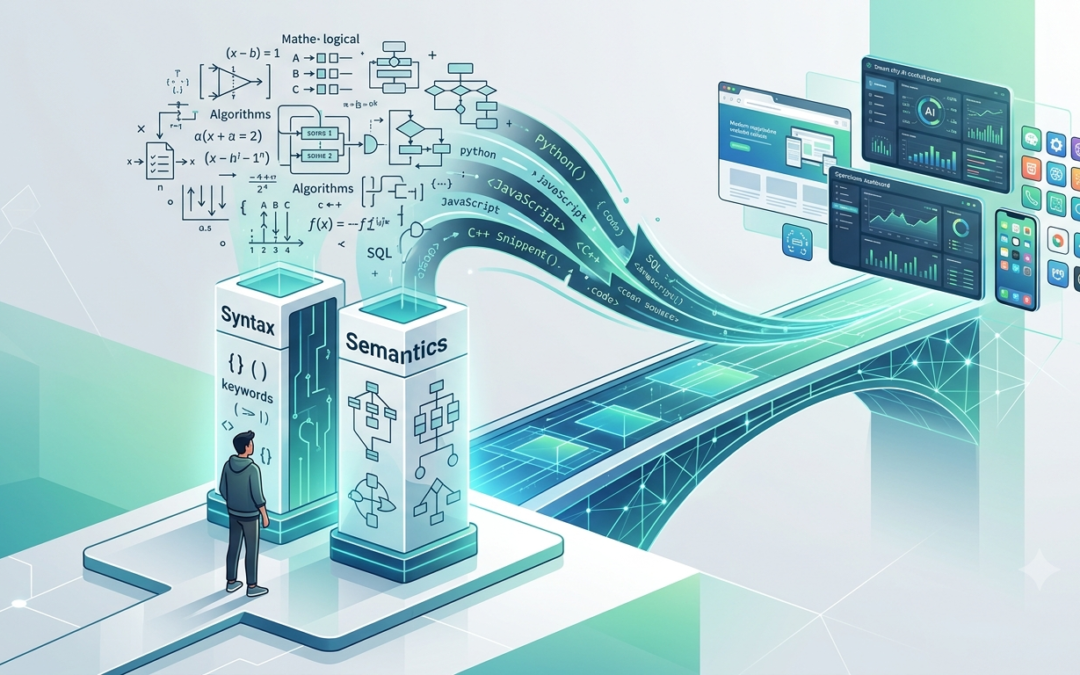
Stop right there, Before You Learn Python, JavaScript, or C++—Understand Syntax and Semantics First
Why do many beginners struggle when they try to solve problems on their own?
Every year, millions of people begin learning programming. Most start with Python, JavaScript, Java, C++, or another popular language. They watch tutorials, follow online courses, and quickly become familiar with terms like variables, functions, loops, objects, and classes.
Yet many beginners struggle when they try to solve problems on their own.
Why?
Because:
They often learn what to write before understanding how programming languages work.
Before diving into any programming language, there are two fundamental concepts every learner should understand:
- Syntax
- Semantics
These concepts form the foundation of every programming language ever created.
What Is Syntax?
Syntax is:
The set of rules that defines how code must be written.
Think of it as grammar in a spoken language.
In English, the sentence:
I am learning programming.
follows the language's grammatical rules.
Writing:
Programming learning am I.
contains the same words, but the arrangement breaks the grammar.
Programming languages work exactly the same way.
For example
In Python:
print("Hello, World!")
is valid syntax.
But:
print"Hello, World!"
is not.
The computer cannot understand incorrectly structured code, regardless of your intention, as we humans may have some difficulty understanding the unstructured words and sentences spoken.
Every programming language has its own syntax.
- Python values readability.
- Java requires braces and semicolons.
- JavaScript has different conventions.
- SQL has its own grammar entirely.
Learning syntax means learning how to communicate with the computer in a language it can parse correctly.
What Is Semantics?
Semantics is about the behavior and meaning of our program.
If syntax answers "Is the code written correctly?", semantics answers "What does this code actually mean?"
Consider this Python statement:
x = 10
The syntax is correct.
Semantically, it means:
Create a variable namedxand store the value10.
Now consider:
x = "10"
The syntax is still correct.
However, the meaning has changed.
The first stores an integer.
The second stores a string.
Understanding that difference is semantic understanding.
So once again;
Semantics is about the behavior and meaning of our program.
Correct Syntax Doesn't Always Mean Correct Logic
This is one of the biggest misconceptions beginners have.
A program can be syntactically perfect and still produce the wrong result.
For example:
age = 18

if age > 18:
    print("Adult")
The syntax is completely valid.
But if your intention was to include people who are exactly 18 years old, the program is logically incorrect.
The semantic meaning doesn't match the intended behavior.
Programming isn't only about writing valid code.
It's about writing code that correctly represents your intended solution.
Why Beginners Often Get Stuck
Many courses immediately introduce concepts like:
- Variables
- Functions
- Loops
- Classes
- Objects
- Modules
- Decorators
- Frameworks
While these topics are important, beginners sometimes memorize them without understanding the foundation underneath.
As a result, they learn patterns instead of principles.
When they encounter unfamiliar code, they feel lost because they've memorized examples rather than understanding the language itself.
How does Understanding Syntax and Semantics Make Learning Easier and faster
Once you understand syntax and semantics, learning a new language becomes much easier.
Instead of asking:
"How do I write this in Java?"
you naturally think:
- What do I want the program to do?
- What is the meaning (semantics) of my solution?
- How does this language express that meaning using its syntax?
This mindset makes switching between languages significantly easier because the underlying computational concepts remain largely the same.
Think Like a Translator
Imagine you know several spoken languages.
The idea you want to express stays the same.
Only the words and grammar change.
Programming languages work similarly.
The algorithm—the idea—is the same.
The syntax changes.
The semantics should remain consistent.
Experienced developers rarely think in Python or JavaScript first.
They think in logic.
Then they express that logic using the syntax of a particular language.
A Strong Foundation Pays Off
Technology evolves constantly. New programming languages, frameworks, and libraries appear every year. However, syntax and semantics remain fundamental concepts across them all.
Learning these principles early helps you understand code more deeply, debug more effectively, and adapt more quickly to new technologies.
Before chasing the latest framework or mastering advanced language features, spend time understanding how programming languages communicate meaning.
This foundation will serve you throughout your development journey.
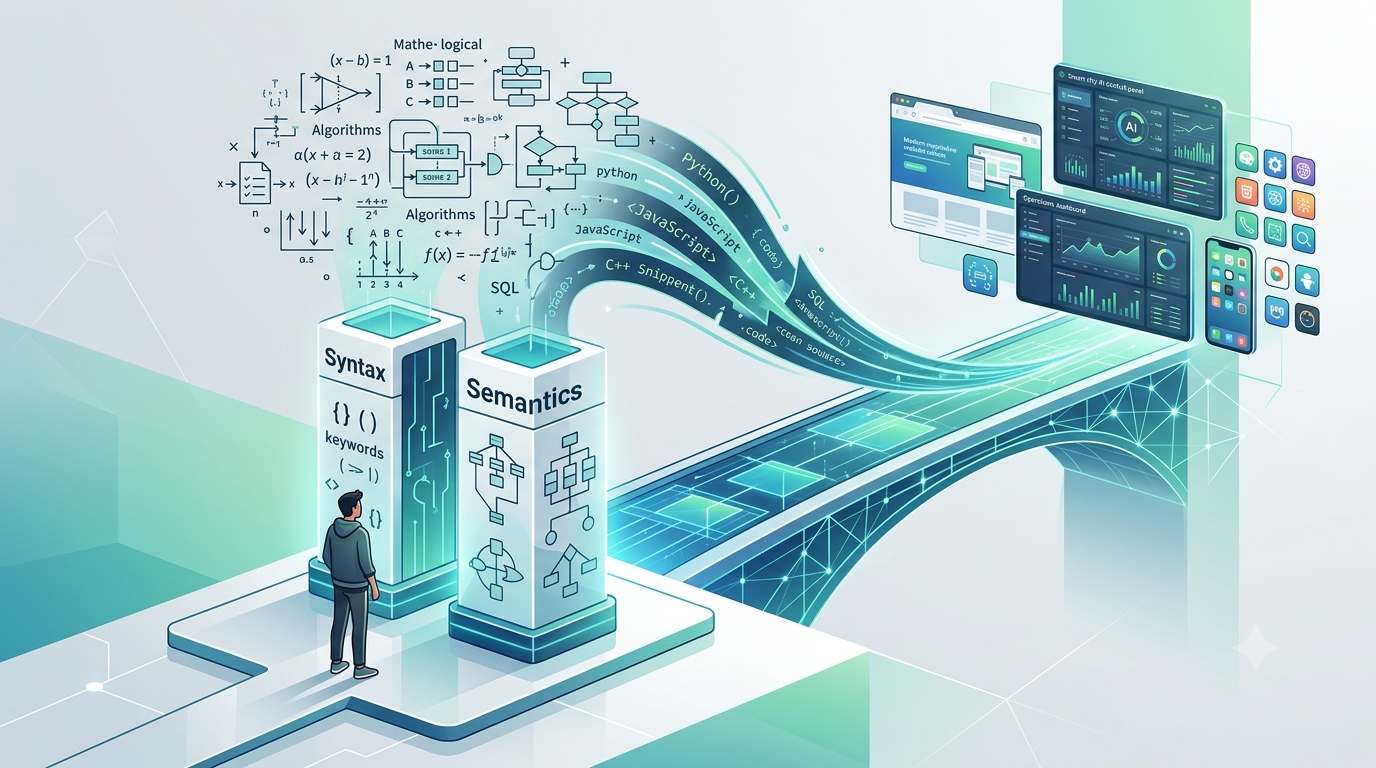
"A programmer who understands syntax and semantics can learn new languages with confidence. A programmer who memorizes only syntax must start over again and again."
Do not miss out checking our related articles.
- Programming Is Not Coding: Understanding the Difference
- How Computers Actually Execute Your Code
- Algorithms Before Programming Languages
- Data vs Information vs Knowledge in Computing
- Compilation, Interpretation, and Execution Explained
- Why Every Programmer Should Understand Abstraction
- The Mental Models That Make You a Better Programmer